Visual Reminders of Fading Traditions

The Rich Traditions Collection centers on visual storytelling as a way to document everyday practices that quietly shift or disappear over time. Historically, artists have used drawing, ink, and wash techniques to record scenes of daily life, social customs, and shared rituals long before photography became widely accessible. From narrative illustration and storyboarding to travel sketchbooks and street-artist souvenirs found throughout foreign cities, illustrated scenes have served as visual records of culture in transition. This collection brings together multiple mediums to preserve those moments, intentionally grouping works by theme rather than technique. Though half of the pieces are rendered in colored pencil and half in ink and wash, they are presented together to emphasize continuity in subject matter and meaning as traditions evolve.
The Process
The colored pencil works in the collection began with hand-drawn sketches on paper planned specifically for a square format. Composition and balance were established early to ensure consistency across the series. Watercolor colored pencils were used to build initial layers of color, with water applied to soften transitions and create a wash-like effect. Once dry, Prismacolor pencils were layered on top to sharpen details, intensify color, and create a crisper, more defined final presentation.
The ink and wash pieces followed a complementary approach. Each began with a pencil drawing on the same square-sized paper to maintain uniformity across the collection. India ink washes were applied to establish tonal values, with each layer allowed to dry fully before additional depth was added. Watercolor was then applied sparingly over the dried ink to introduce subtle pops of color without overpowering the black-and-white structure. The drawings were finalized with black ink pen outlines, resulting in illustrations defined by strong contrast and restrained color.
All four works were framed in matching wooden square frames, reinforcing their presentation as a unified set within the Rich Traditions Collection, despite the intentional mix of mediums.
Inspiration & Meaning
Tractor and Barn: A Country Scene was the first piece in the collection and reflects rural traditions tied to land, labor, and a slower pace of life. The imagery evokes familiarity and stability, capturing the quiet endurance of countryside routines. The piece was exhibited at The Lewisville Playhouse during the production of Uncle Vanya in April 2025, where its subject matter echoed the play’s rural setting.
Handwriting Thoughtfulness follows and reflects upon the gradual disappearance of handwritten correspondence and etiquette. The work considers how personal care and intention once embedded in communication have been replaced by speed and convenience. It was exhibited at The Grand Theater Gallery as part of the Abandoned Exhibition in May 2025, aligning with its theme of overlooked and fading practices.
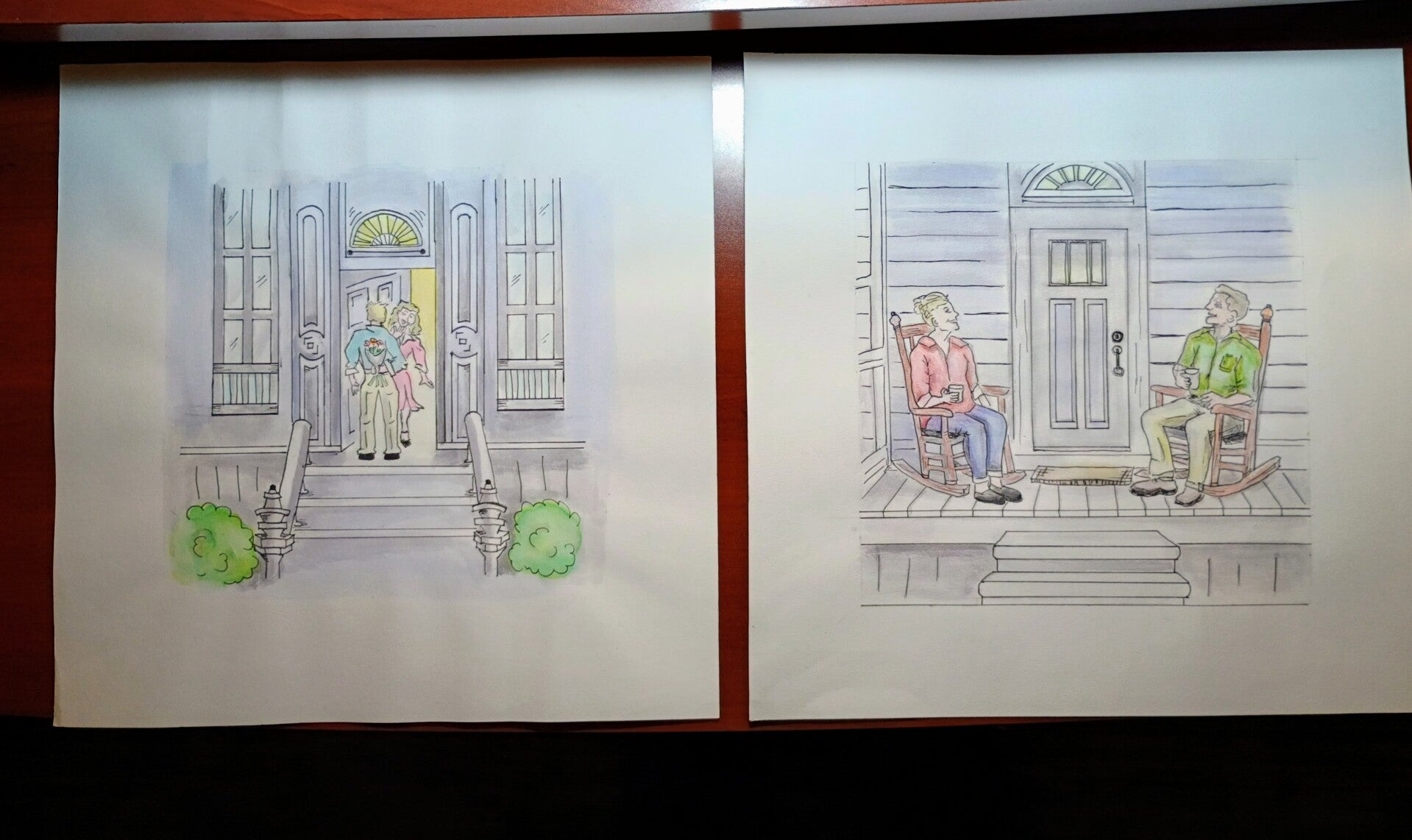
Later, Date was introduced using ink and wash to explore traditional courtship within a modern context. The gesture of arriving with flowers recalls formality and intention while acknowledging how relationship norms have shifted. Date was exhibited at The Lewisville Playhouse in the Alphabet Soup Exhibition from August through October 2025.
Quality Time was the final addition to the collection, completing the narrative with a second ink and wash illustration. The scene emphasizes the value of unhurried, face-to-face connection, recalling a time when presence itself was central to building relationships.
Exhibited both individually and as a collection, the Rich Traditions Collection functions as a visual archive of evolving customs. Displayed in matching square frames, the works invite viewers to reflect on how traditions change, how meaning is preserved, and how illustration continues to serve as a tool for documenting human connection over time.
See The Rich Traditions Collection
See Handwriting Thoughtfulness, Tractor and Barn: A Country Scene, Date , andQuality Time




Video: See Handwriting Thoughtfulness in the Abandoned Exhibition in May 2025